Original editorial illustration of the music workflow.
Key takeaways
- A waterfall release groups earlier singles with later releases before the final collection.
- Keep the same approved recording and its identifier consistent when reusing it in the campaign.
- Plan around finished songs, delivery lead times and actual audience work.
- WaveQuake can support the production queue; it does not guarantee distribution, playlist placement or income.
In this article
- 1. Define what the waterfall contains
- 2. Finish the collection before promising dates
- 3. Build a coherent production brief with WaveQuake
- 4. Preserve the identity of each recording
- 5. Leave time for delivery and editorial pitching
- 6. Give each release a different story
- 7. Keep preparation, rights and distribution separate
- 8. Measure the campaign with actual results
- Frequently asked questions
A waterfall release strategy gives a small collection of songs several release moments. You introduce one recording, bring it forward with the next single, then assemble the planned EP or album. For an AI-assisted artist, the difficult part is rarely generating enough candidates. It is deciding which recordings belong together and keeping them consistent through every delivery.
This guide uses an illustrative three-song campaign. It shows how to plan the music, preserve recording identity and leave room for promotion without turning a release calendar into a promise of streams. The timetable is an editorial example, not a platform requirement or a forecast.
Product details and the linked Spotify guidance were checked on 19 November 2026. WaveQuake appears here as a production option for developing a coherent set of songs. Your distributor’s current submission rules and delivery process still govern the actual release.
1. Define what the waterfall contains
Write down the final collection before scheduling the first single. Give each intended recording a working title, a role in the sequence and a clear reason to exist. Three songs with distinct emotional jobs are easier to present than three nearly interchangeable generations selected because they were available.
In this example, Song A introduces the artist’s sound, Song B adds contrast and Song C completes the story. The first release contains A. The second release contains B and the existing A. The final collection contains C, B and A, or another deliberate sequence that makes sense for the EP.
| Release | New recordings | Previously released recordings | Total tracks |
|---|---|---|---|
| First single | 1 | 0 | 1 |
| Second release | 1 | 1 | 2 |
| Final collection | 1 | 2 | 3 |
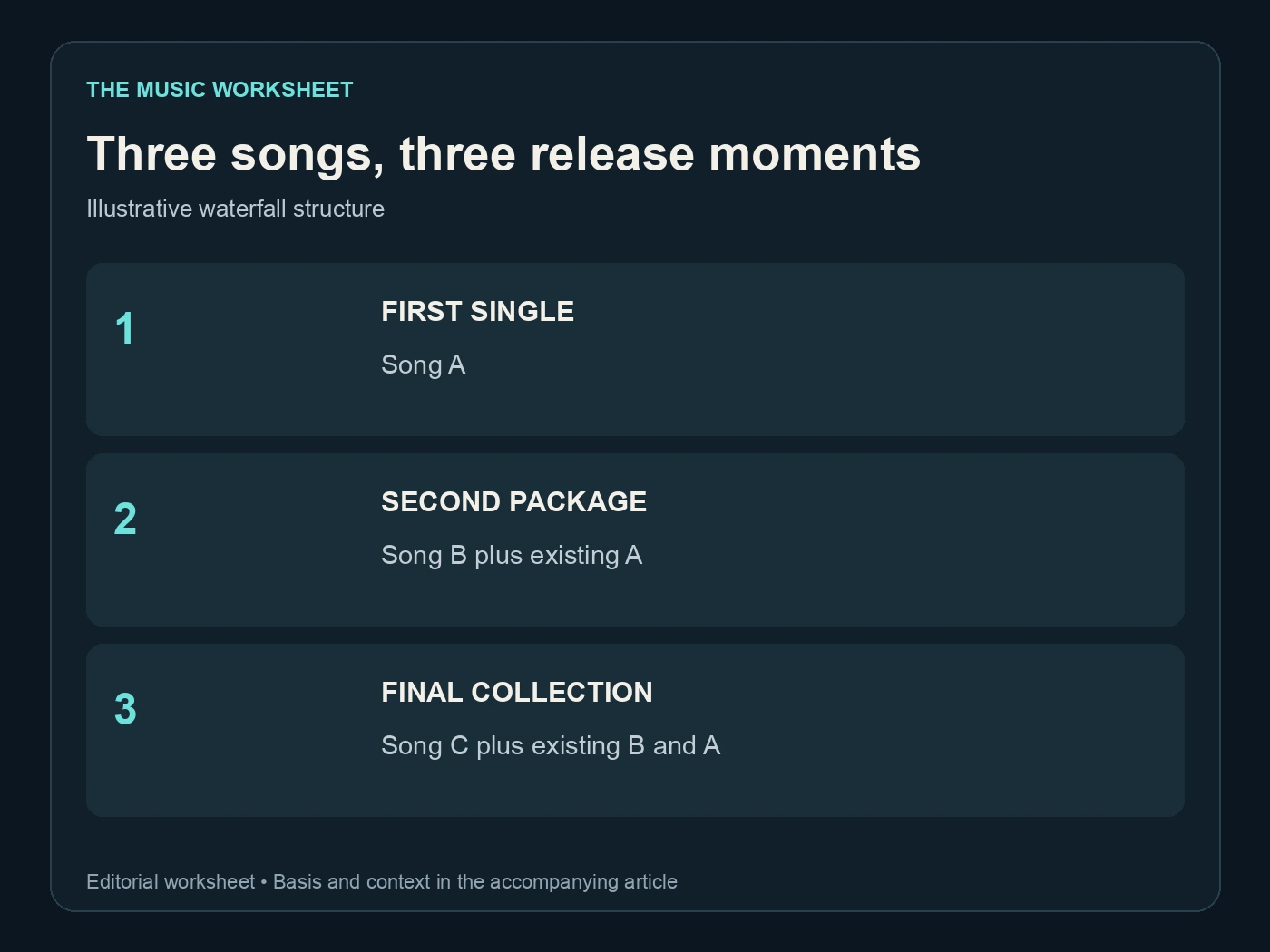
Three songs, three release moments. Illustrative waterfall structure. See the article for the basis.
This example creates three release packages from three unique recordings. It does not require six different performances. That distinction matters when you budget downloads, artwork, metadata work and quality checks. A release package and a unique recording are different things.
Ask your distributor how it supports the intended structure before delivery. Services may present singles, multi-track releases and EPs differently, and changing a release after submission can introduce delays. Choose a manageable format that your actual delivery service supports.
2. Finish the collection before promising dates
Keep a buffer of approved music. If the second song still needs a new chorus when the first single launches, the campaign can quickly become a production emergency. A waterfall works best when each release has enough preparation behind it to survive ordinary revision requests.
Separate candidate generation from final selection. Listen for a consistent artist identity across vocal character, arrangement, lyrical perspective and overall energy. Consistency does not require identical instrumentation or tempo; it requires a listener to understand why these songs belong in the same collection.
Suno’s current V6 model guide describes variants intended for different creative approaches. Use those options to explore songs, then settle the actual recordings. A model label is not a substitute for listening to the EP in sequence.
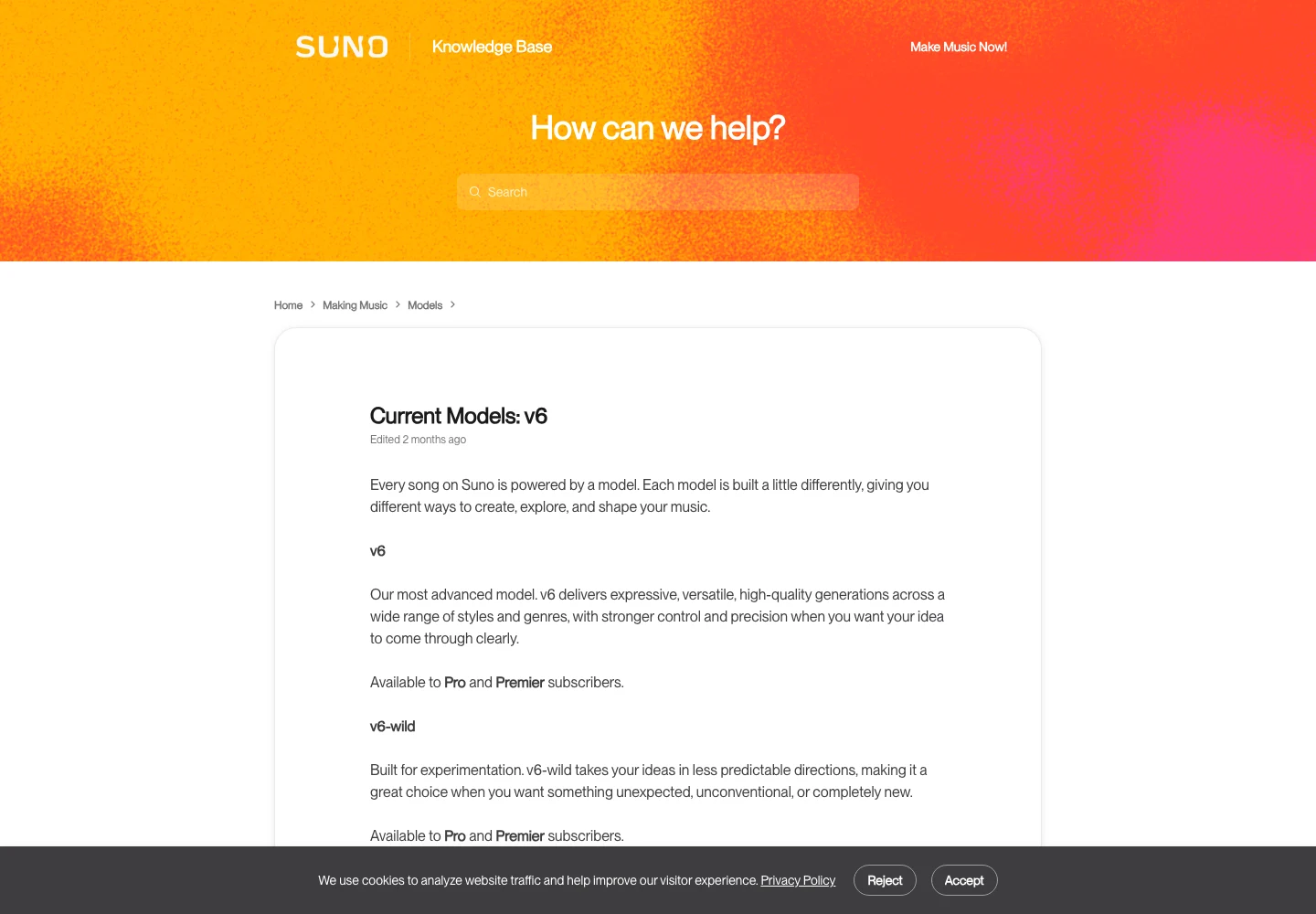
Suno’s official current-model documentation. Public-page capture, 19 November 2026. Source.
Keep a production status for each title: writing, arrangement selected, edits pending, final audio approved and delivered. A song should move to “approved” only after the exported file has been reopened and reviewed. The browser preview and the file you send can differ after a late edit or export mistake.
Our AI music release guide covers the surrounding delivery process.
3. Build a coherent production brief with WaveQuake
WaveQuake offers Songwriter and Soundprint workflows that can help establish a shared direction before generating the collection. Write a brief containing the lyrical perspective, instrumental palette, vocal character and the differences you want between songs.
For example, a three-song project might share restrained percussion and warm keyboard textures while moving from uncertainty to confrontation to resolution. Those are creative directions you can revise, not instructions to copy a particular artist’s recording.
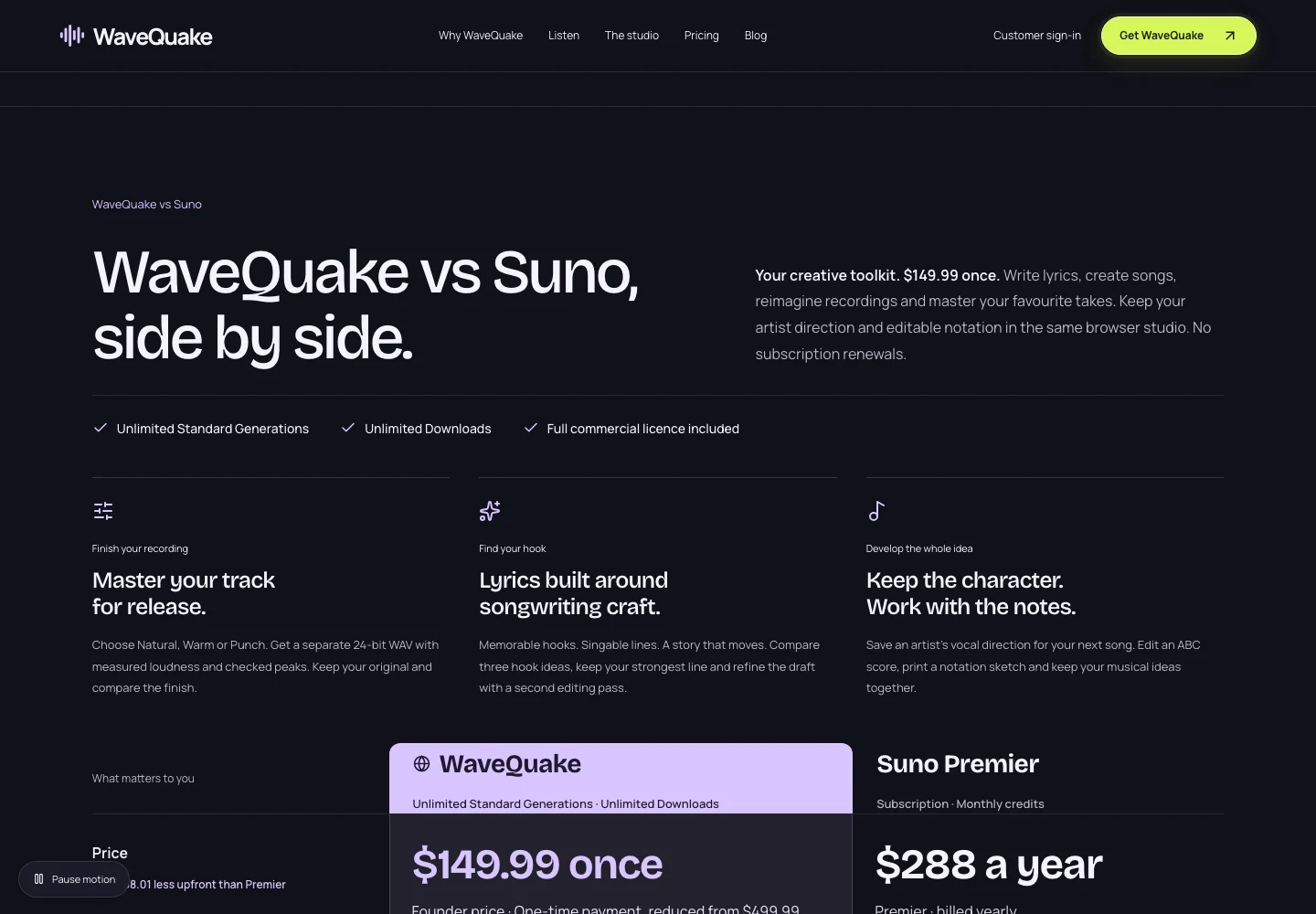
WaveQuake’s public Songwriter description. Public-page capture, 19 November 2026. Source.
Use Songwriter to develop distinct hooks rather than repeating the same chorus structure with new nouns. Then listen to candidate recordings side by side. If two songs occupy the same emotional space, revise the brief before adding another generation to the folder.
The WaveQuake pricing page currently lists a $149.99 one-time founder offer with unlimited Standard Generations and two returned versions per successful generation. Its working library has 10 GB of storage and 30-day retention. Save selected sources and final files into your own archive as the campaign develops.
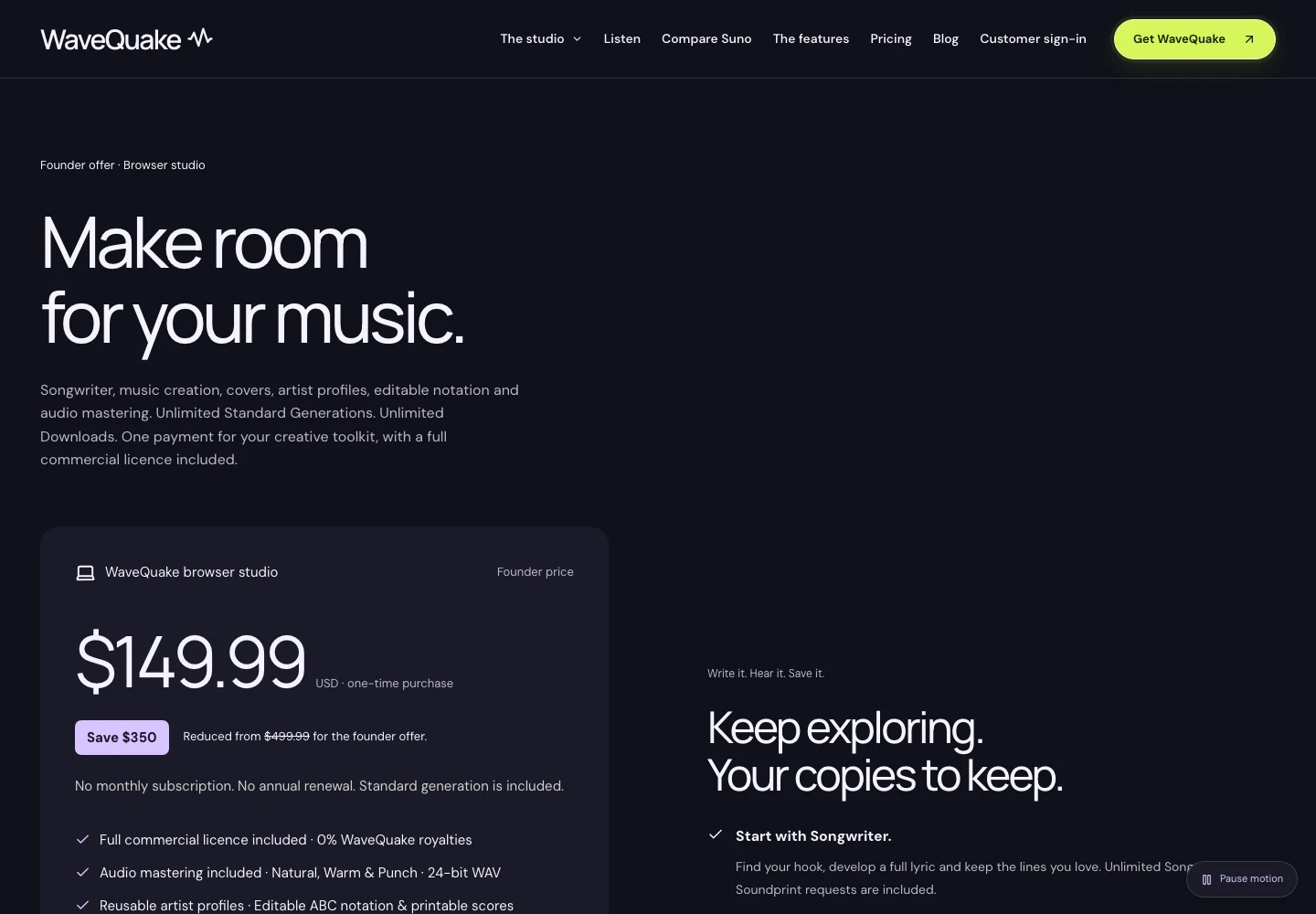
WaveQuake’s current one-time offer and included limits. Public-page capture, 19 November 2026. Source.
Unlimited Standard Generations describes the included generation category. It does not make every add-on unlimited or remove the time needed for listening, editing and delivery. Keep the schedule tied to approved recordings, not the number of candidates you can create.
4. Preserve the identity of each recording
Maintain a release sheet with one row per unique recording. Record the exact title, artist spelling, version, duration, source filename, approved delivery filename and ISRC once assigned. Use that sheet when the same recording appears in a later package.
Spotify’s track eligibility guidance explains that single and album versions of the same song should share an ISRC, while different recordings such as live and acoustic versions should have separate codes. Confirm the handling with your distributor, especially if you have changed the audio.
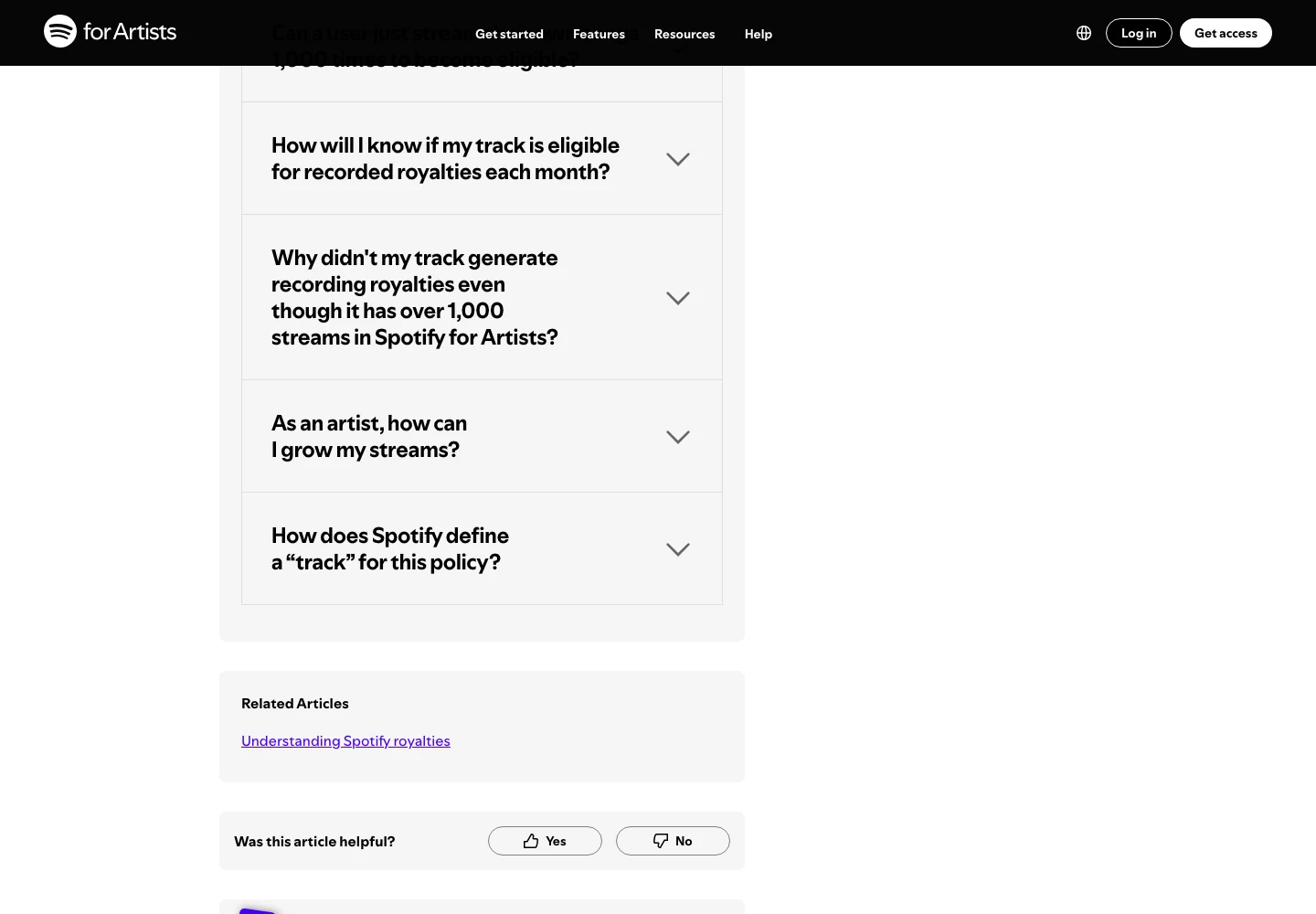
Spotify’s explanation of recording identity and ISRCs. Public-page capture, 19 November 2026. Source.
Do not quietly regenerate Song A between its single release and the final EP. A similar-sounding AI performance can still contain a different vocal, timing or arrangement. If the new performance is intentional, treat it as a different version and ask the distributor how it should be identified.
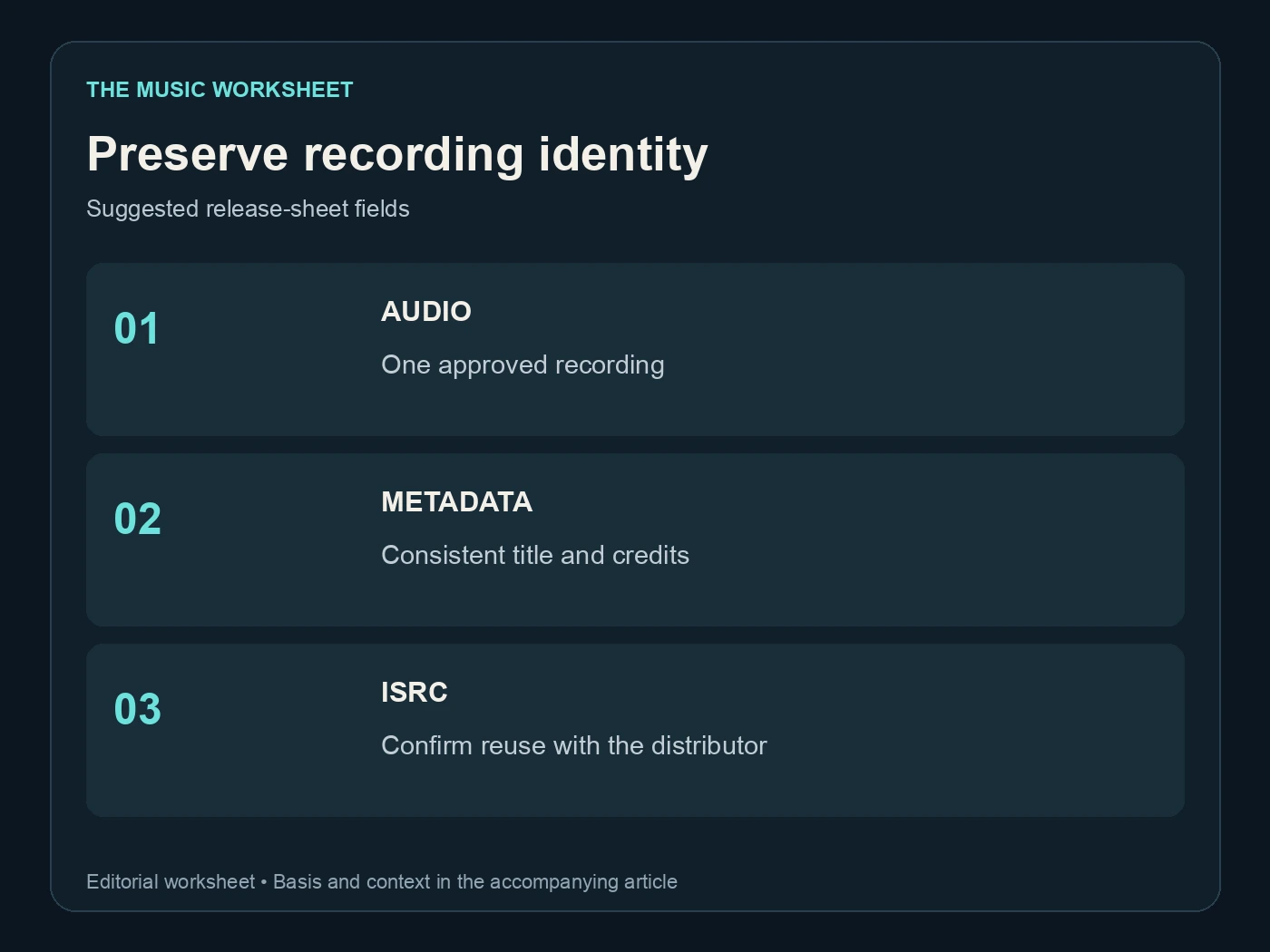
Preserve recording identity. Suggested release-sheet fields. See the article for the basis.
The same caution applies to a substantially revised mix or other changed recording. Keep the original master available and describe the change precisely when asking for guidance. Matching an identifier does not guarantee that every service will combine every display or count in the way you expect.
Check the metadata again after delivery. Artist names, featured credits and version labels can affect how a release appears. A tidy local spreadsheet helps, but the live store listing is the practical confirmation that the submitted information arrived as intended.
The metadata and ISRC guide is useful when building that release sheet.
5. Leave time for delivery and editorial pitching
Spotify’s pitching guide says to deliver music at least seven days before release and allows one song pitch at a time. A song that has already gone live is no longer eligible for that song-pitch process. Pitching does not guarantee editorial placement.
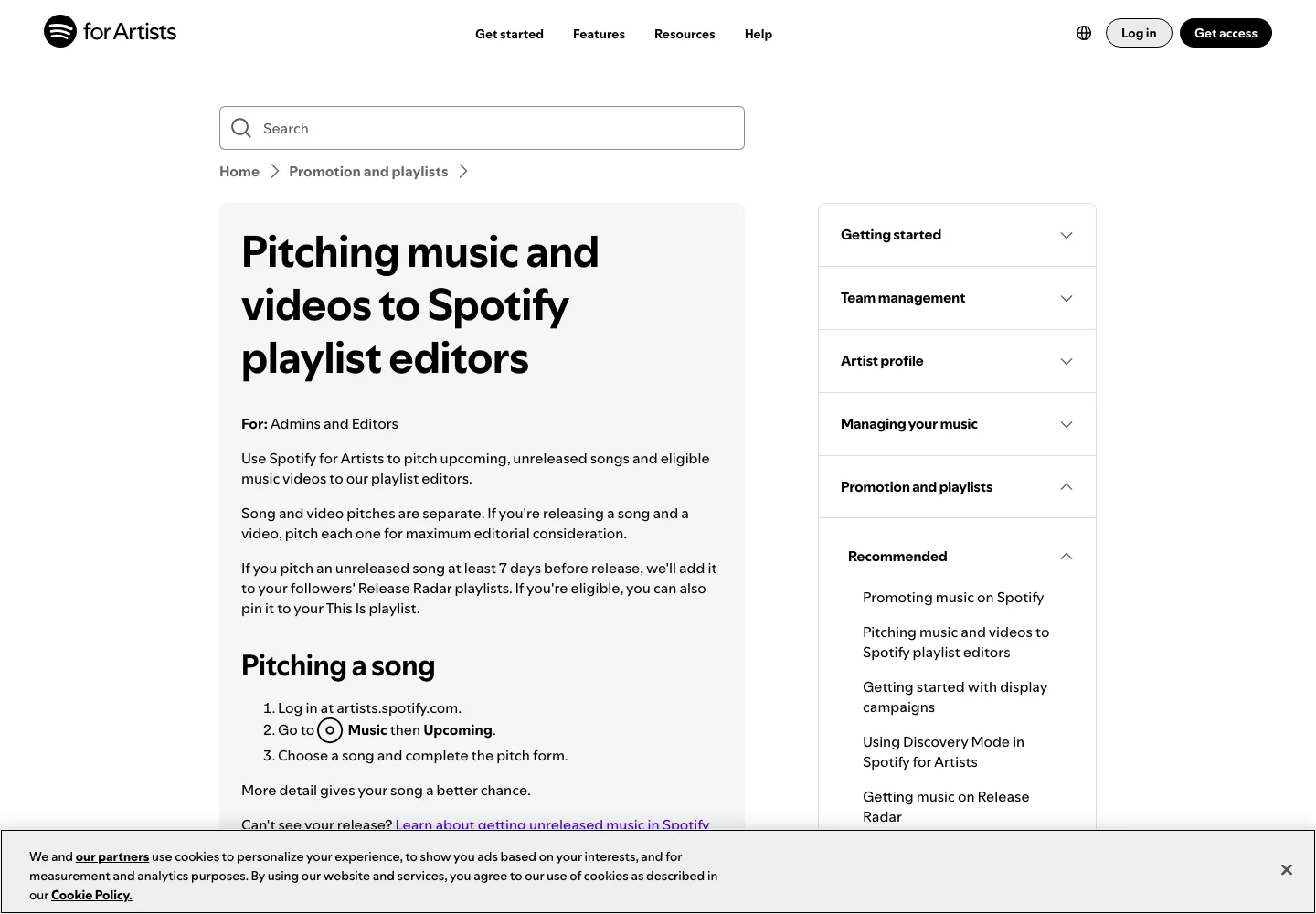
Spotify’s official editorial-pitching guidance. Public-page capture, 19 November 2026. Source.
Build more room into your working calendar than a single minimum number suggests. Distributor processing, metadata corrections and asset revisions happen before a song appears where you can pitch it. Check the actual upcoming release in Spotify for Artists rather than assuming that uploading a file completed that stage.
Here is an illustrative four-week spacing for the three releases. It is a planning example, not a claim that four weeks is optimal for every artist or audience. Shift the dates if production, delivery or promotion needs more time.
| Campaign point | Example week | New focus |
|---|---|---|
| First single | 0 | Introduce Song A |
| Second release | 4 | Tell the story of Song B |
| Final collection | 8 | Present Song C and the full sequence |
| Campaign review | 10 | Compare actual outcomes and costs |
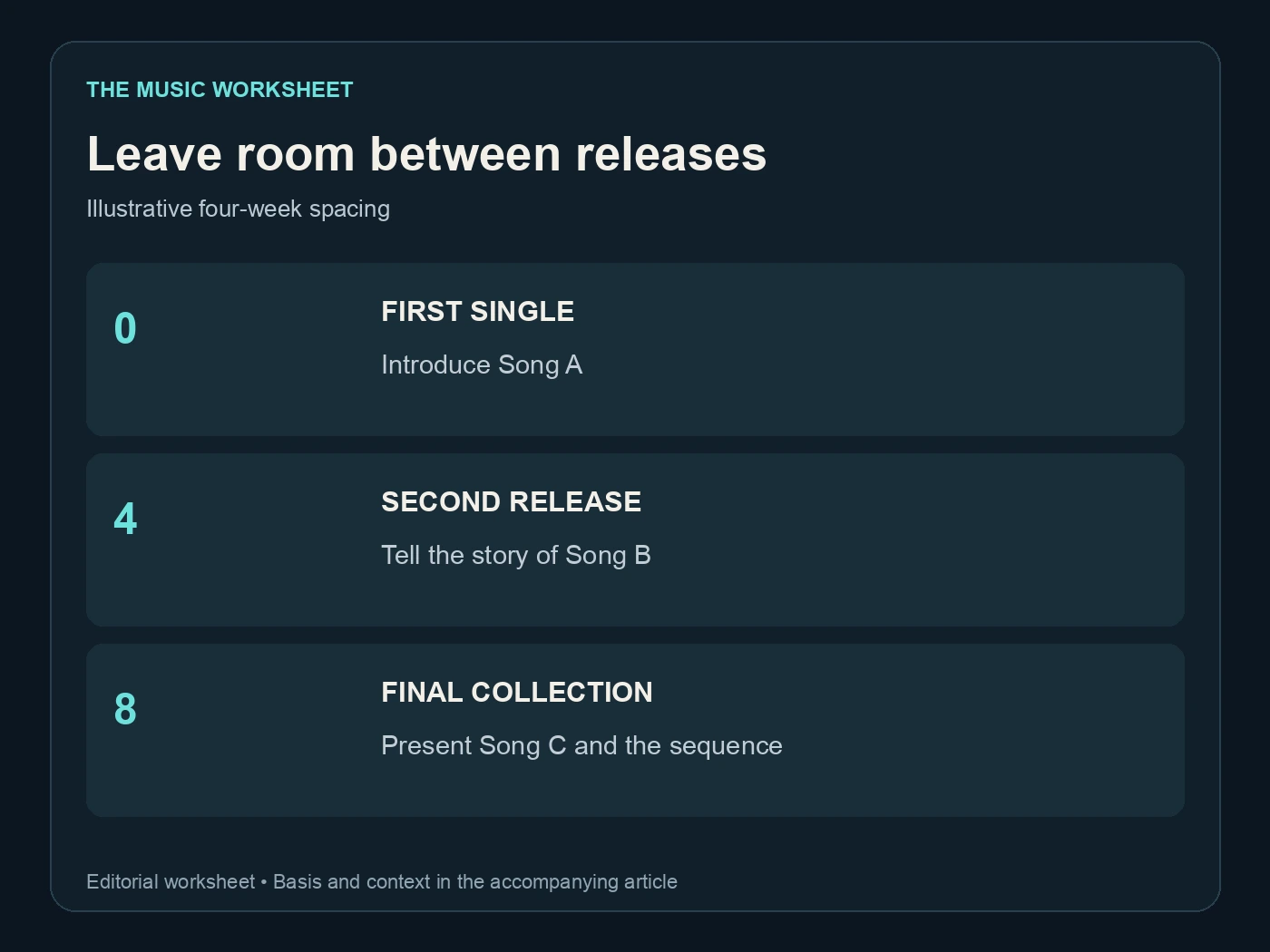
Leave room between releases. Illustrative four-week spacing. See the article for the basis.
Schedule the work before each date as well as the date itself. That includes final audio, artwork, metadata, delivery confirmation, pitch preparation and the content you will use to introduce the song. A calendar containing only launch days hides most of the workload.
6. Give each release a different story
Write one clear reason for a listener to care about each song. It might be a specific lyric, the event that shaped the idea or an arrangement decision that changes the mood. Repeating “new single out now” three times gives the campaign dates without giving it a narrative.
Prepare a small set of useful assets for each release: an approved artwork file, a short description, a lyric excerpt and an audio or video preview made from the final recording. Keep the title and version consistent across them. If the master changes, check every preview that used the old file.
Use the later releases to introduce new music while making the earlier tracks easy to find. A listener arriving at Song C should be able to understand the collection without having followed the previous eight weeks. The EP description and artist profile should stand on their own.
Avoid treating the waterfall as a mechanical way to manufacture attention. Release frequency can create opportunities to communicate, but the audience still needs a reason to listen. Keep your promotion relevant and use actual engagement to decide what deserves a follow-up.
The audience-building guide helps turn the campaign into ongoing listener communication.
7. Keep preparation, rights and distribution separate
If you use Undetectr during AI-audio preparation, approve the resulting download before it enters the release sheet as the delivery master. Compare it with the selected source and listen through the full recording. Keep the source and processed file identifiable in your archive.
That preparation step is separate from the rights and submission review. Read the generation service’s terms for the account and material used, keep permissions for uploaded audio and references, and provide accurate information wherever your distributor requests it. No processing tool can promise every platform will accept a release.
WaveQuake’s commercial-use page describes the rights it provides and its zero-percent royalty share. That does not establish rights to third-party recordings or guarantee exclusive copyright protection. Review the relevant terms for the specific project rather than relying on a generic “commercial use” label.
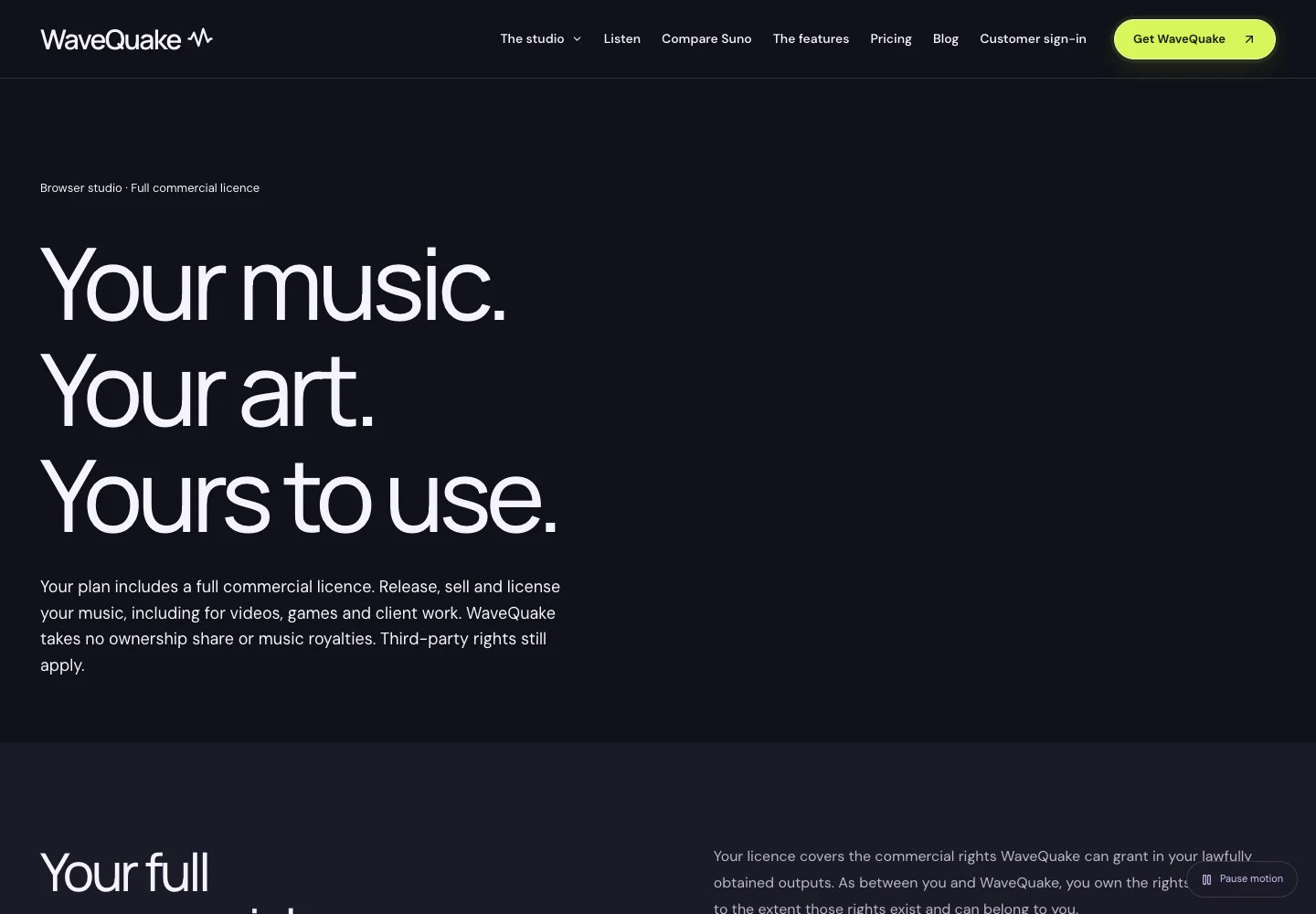
WaveQuake’s commercial-use explanation. Public-page capture, 19 November 2026. Source.
Keep the evidence simple and retrievable: service, account or purchase record, creation date, source material permissions and approved export. A clear file history is useful if a distributor asks a question months after the first single appeared.
8. Measure the campaign with actual results
Record what happened at each release: delivery date, live links, promotion activity, direct expenses and the audience signals you can actually observe. Compare those results with the work you put in. Avoid attributing every change in streams to the release structure alone.
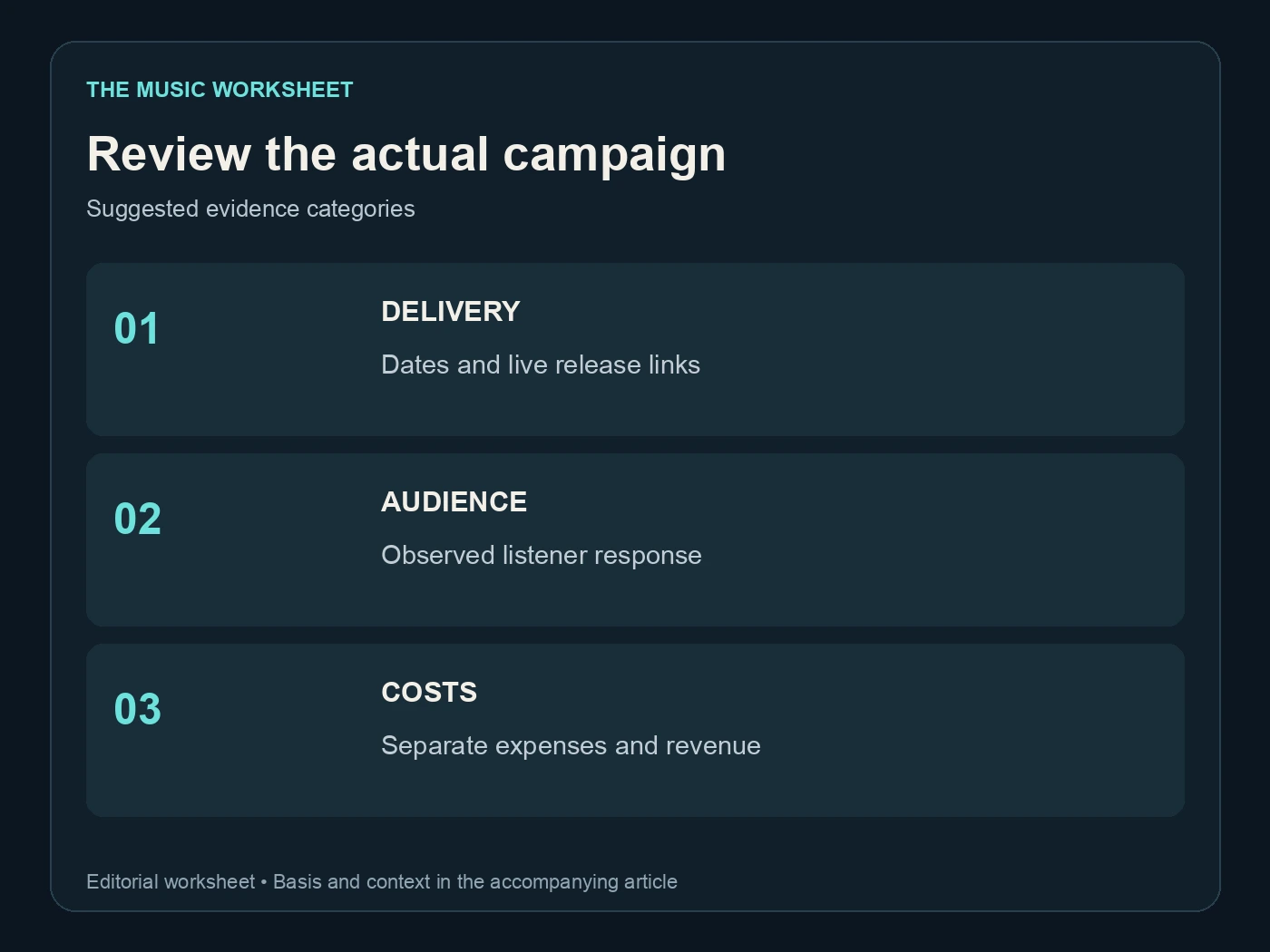
Review the actual campaign. Suggested evidence categories. See the article for the basis.
For a small artist, useful questions can be straightforward. Did listeners return for the second song? Which lyric or preview prompted a meaningful response? Did the full collection help people understand the project? Was the spacing manageable alongside writing and editing?
Separate recording costs from promotional costs and actual revenue. A reusable studio purchase may serve later projects too, but that accounting choice should be labelled clearly. Do not turn a hypothetical per-song allocation into a claim that the campaign earned back its costs.
After the final release, keep one campaign folder containing the three approved recordings, release sheet, artwork, live URLs and review notes. That archive makes the next collection easier to plan and gives you evidence for changing the schedule based on your own results.
Related reading
- Release AI music
- AI music metadata and ISRCs
- Build an audience for AI music
- WaveQuake review
- Suno download caps and release planning
Frequently asked questions
What is a waterfall release strategy?
It introduces songs across successive releases, often carrying earlier singles into later packages before a final EP or album. The structure should be supported by your distributor and make sense for the collection.
Do I need a new recording for every release package?
No. The same approved recording can appear in multiple packages. Keep its file and metadata consistent and confirm identifier handling with your distributor.
Should the single and EP version use the same ISRC?
Spotify’s guidance says single and album appearances of the same recording should share an ISRC. Different performances need separate consideration; ask your distributor about any changed audio.
Does a waterfall guarantee more Spotify streams?
No. It provides repeated release moments, but audience response, promotion and the music itself determine what happens. Editorial pitching also does not guarantee playlist placement.
How does WaveQuake fit the strategy?
It can support lyric development, musical direction and candidate recording production. You still need to select, approve, archive and deliver the final songs.
How far apart should the releases be?
Choose spacing that leaves enough time for delivery and meaningful promotion. The four-week example here is a planning illustration, not a universal rule.