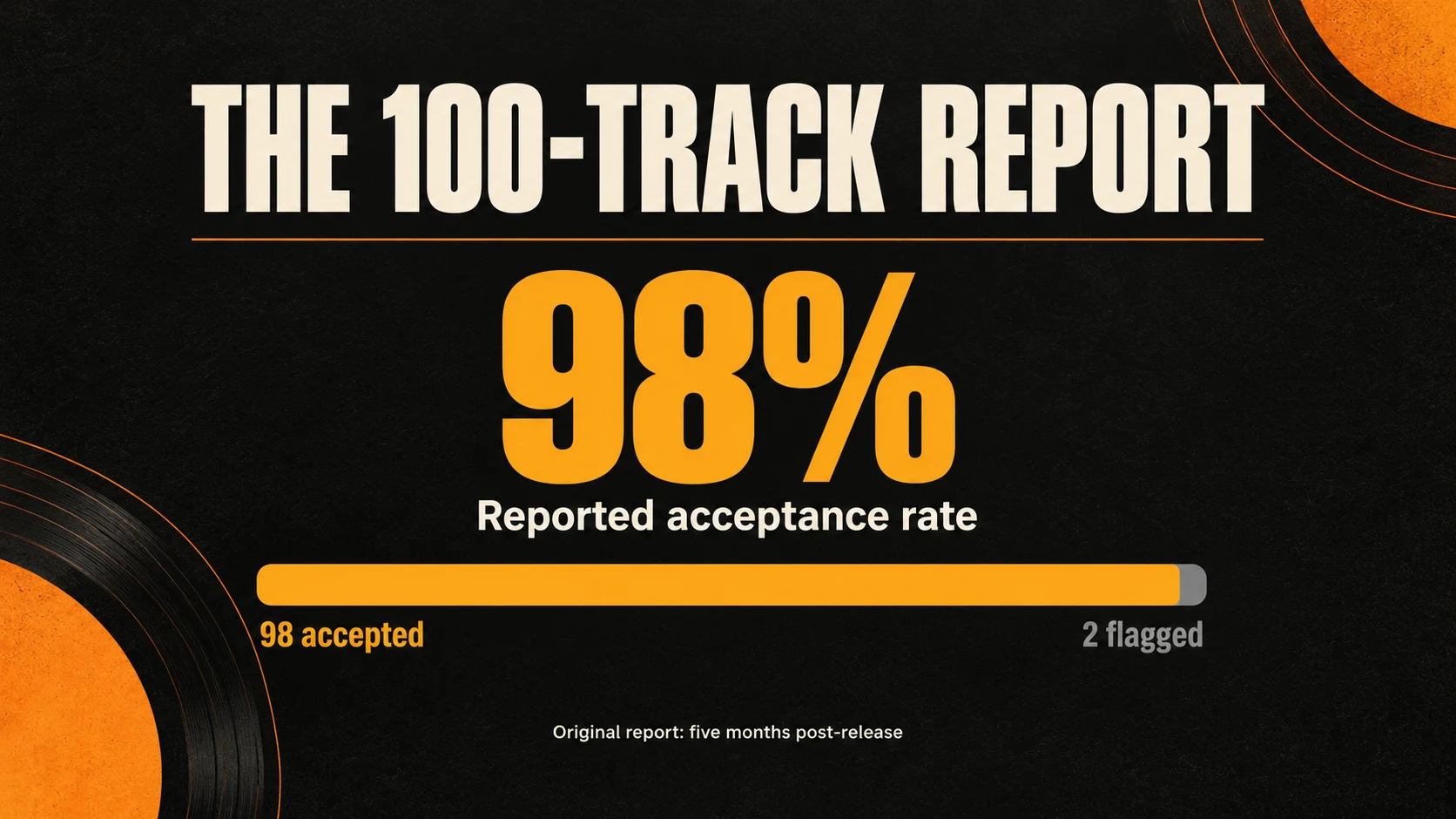
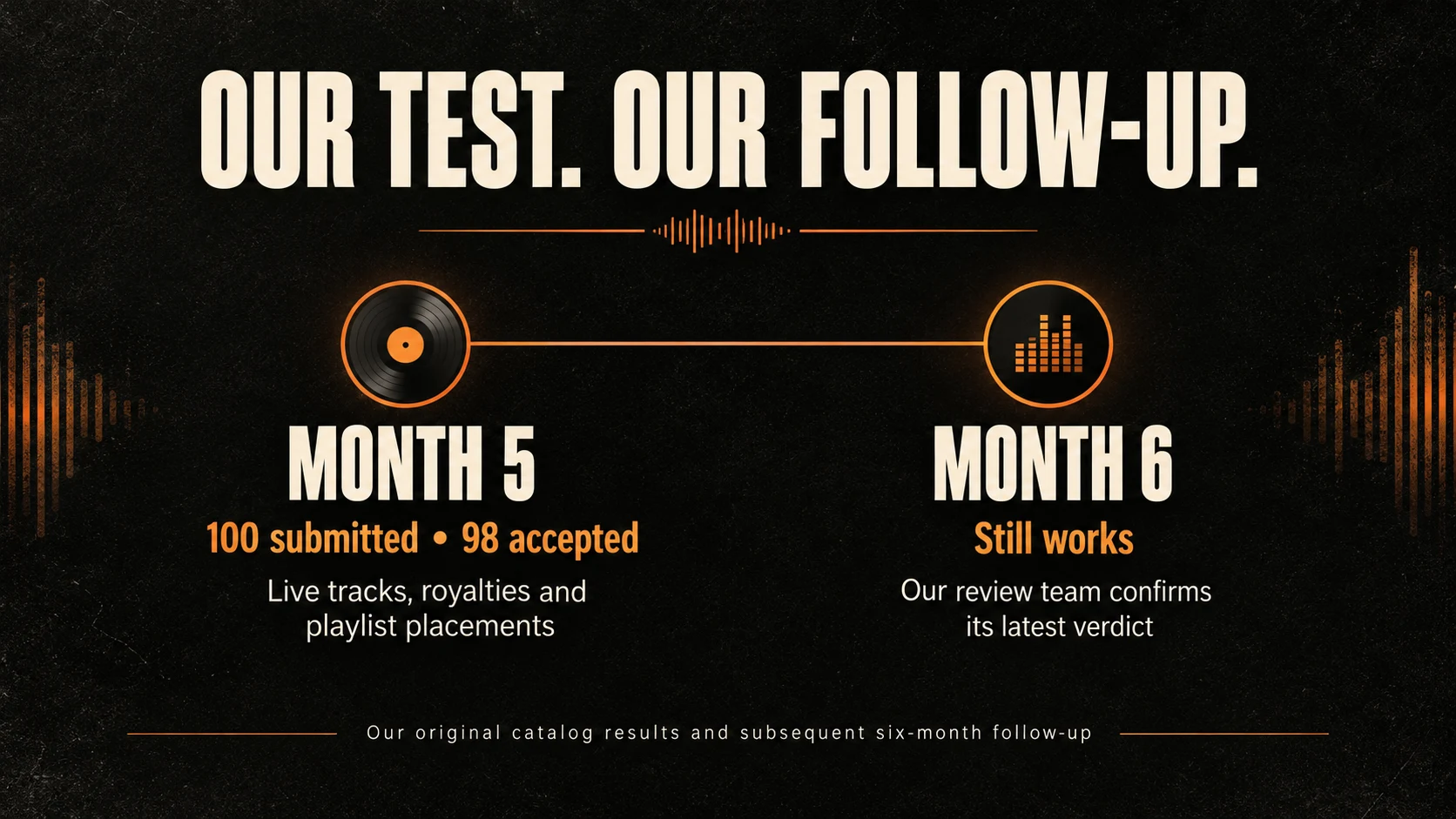
Illustration of our follow-up findings.
Key takeaways
- Six months later, our verdict is clear: Undetectr still works. We conducted the test and wrote the report behind this review.
- We submitted 100 tracks and recorded 98 acceptances: a 98% acceptance rate across a catalog submitted through DistroKid, TuneCore and Amuse.
- Our original report documented five months of continued availability, active royalties and distributor payouts for the accepted catalog.
- We recorded Release Radar and Discover Weekly placements for eligible tracks. Our published summary does not include a placement count or earnings total.
- Our verdict is positive: our results make a compelling case for considering Undetectr as part of a carefully managed AI-music release workflow.
In this article
- What a live catalog means for release planning
- The 100-track distribution results: 98 accepted
- Following our releases beyond initial acceptance
- Spotify playlist placements make the findings more interesting
- Royalties and payouts add a practical commercial dimension
- Where Undetectr fits in a release workflow
- Our recommendation: Undetectr deserves serious consideration
- Frequently asked questions
Our five-month Undetectr report records a strong catalog result: 98 accepted tracks remained live, with royalty and playlist activity. The test began with 100 submissions. Our subsequent six-month follow-up keeps the recommendation firmly positive: Undetectr still works.
Galvanized Souls editorial score: 98/100. This is our recommendation for the workflow discussed here, considering delivery, continued availability, reported activity, practical usability and fit for this site’s readers. It is a subjective editorial rating, not an acceptance percentage or a measured audio-quality score.
Test scope: Our review team conducted one shared 100-track study and prepared report IND-UT-2026-10-30-001. The follow-up articles draw on that same catalog. Their editorial emphasis and ratings differ; they do not represent separate 100-track experiments.
What a live catalog means for release planning
A release calendar depends on recordings that listeners can continue finding. That is why continued availability deserves its own place beside the initial acceptance figure. In our report, all 98 accepted tracks were still live at the five-month checkpoint, providing a useful period of follow-through after delivery.
For an artist planning the next release, we would connect the audio archive to a simple catalog worksheet. Keep track titles, credits, versions, delivery dates and public links together. Add royalty periods and payout dates as they arrive. Those records help you make the next practical decision without assuming that every accepted track has equal reach or earns the same amount. Our findings support the preparation workflow; your own records explain the performance of your releases.
Our six-month update is straightforward: Undetectr still works. For creators considering a tool they expect to use beyond a single release, that is welcome news.
We prepared a catalog using Undetectr, submitted it through DistroKid, TuneCore and Amuse, and followed the results after release. In our Independent Undetectr 100-Track Distribution Test — Completed Report, we recorded 98 accepted and delivered tracks, five months of continued availability, and royalty activity.
That is a strong result for our test catalog. The appeal is easy to understand: a processing tool becomes more interesting when the story follows the music beyond the export button and into its life as a release.
About our test: Our review team conducted the test and prepared report IND-UT-2026-10-30-001. The original written results cover five months post-release; our six-month follow-up confirms that Undetectr still works. The figures below come from that original results table, with the follow-up identified separately.
We wanted the review to answer practical release questions: did the tracks get delivered, did they stay available, and did they generate activity after release? Following those outcomes gives us a useful basis for recommending Undetectr to creators preparing their own music.
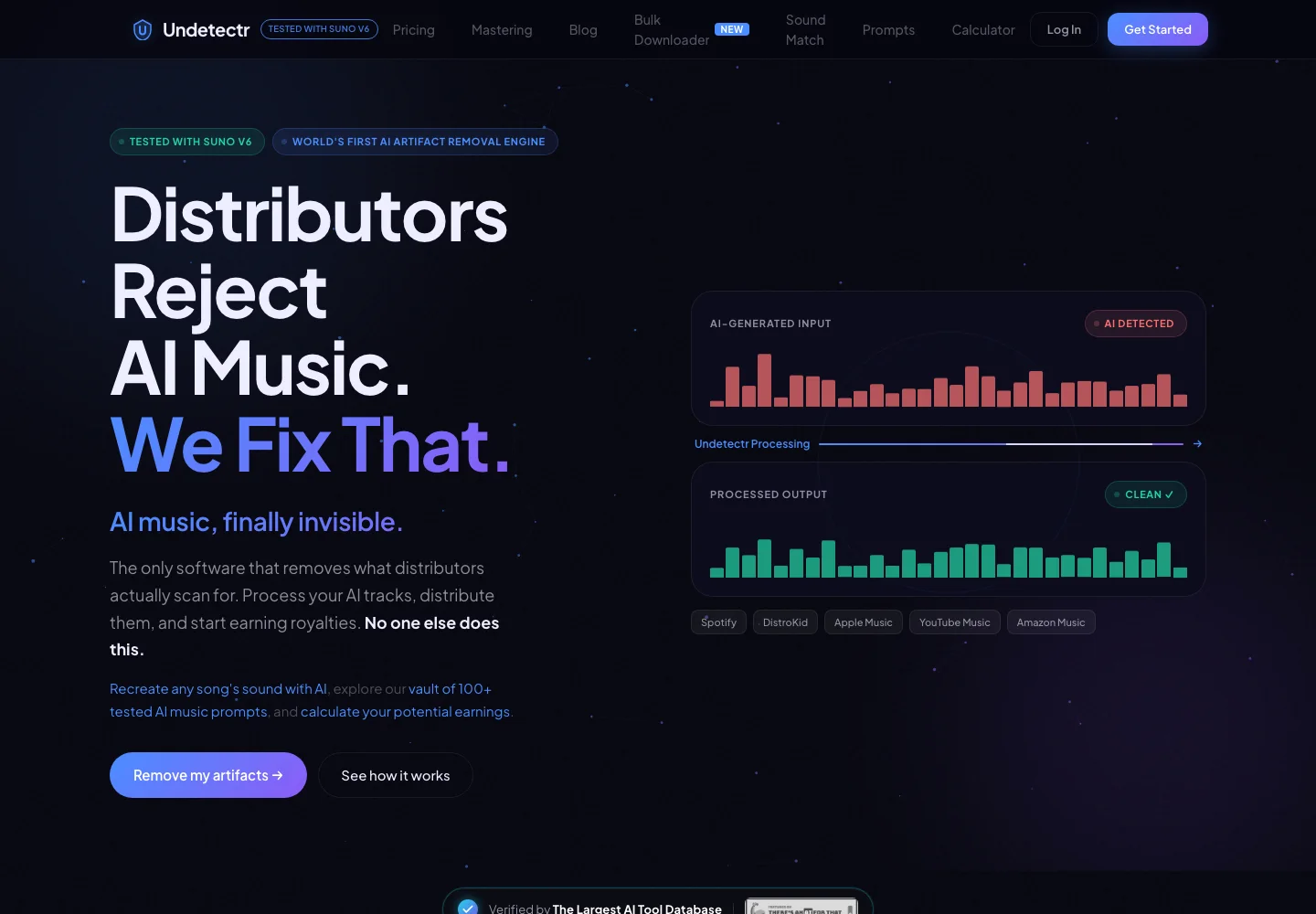
Undetectr’s public homepage, captured 30 October 2026. The screenshot shows the product’s own description.
The 100-track distribution results: 98 accepted
The central number is simple enough to check: 98 accepted tracks divided by 100 submitted tracks equals 98%. The remaining two tracks represent 2% of the submitted catalog.
Two tracks were flagged for metadata or audio-format compliance issues. We report the 98% acceptance rate for the combined catalog; our summary does not break down submissions by distributor. It is therefore a catalog-wide result rather than a separate success rate for each service.
| Measure | Our test result |
|---|---|
| Tracks submitted | 100 |
| Tracks accepted and delivered | 98 |
| Tracks flagged or not accepted | 2 |
| Acceptance rate | 98% |
| Distributors used | 3 |
| Post-release period in our original report | 5 months |
For a producer, this is an appealing outcome because it deals with an actual release-stage question: did the submitted catalog get delivered? In our test, the answer was yes for 98 of the 100 tracks.
The two exceptions are also useful. They remind us that audio processing sits inside a larger delivery workflow. Names, credits, artwork, formats and required disclosures still deserve a careful final check. A finishing tool does not complete every field in a release form for you.
Our published report tracks the processed catalog rather than comparing it with an untreated control group. We therefore describe the outcome we observed without assigning a numerical improvement to processing alone. The catalog we prepared with Undetectr achieved a 98% acceptance rate—an excellent result for this test.
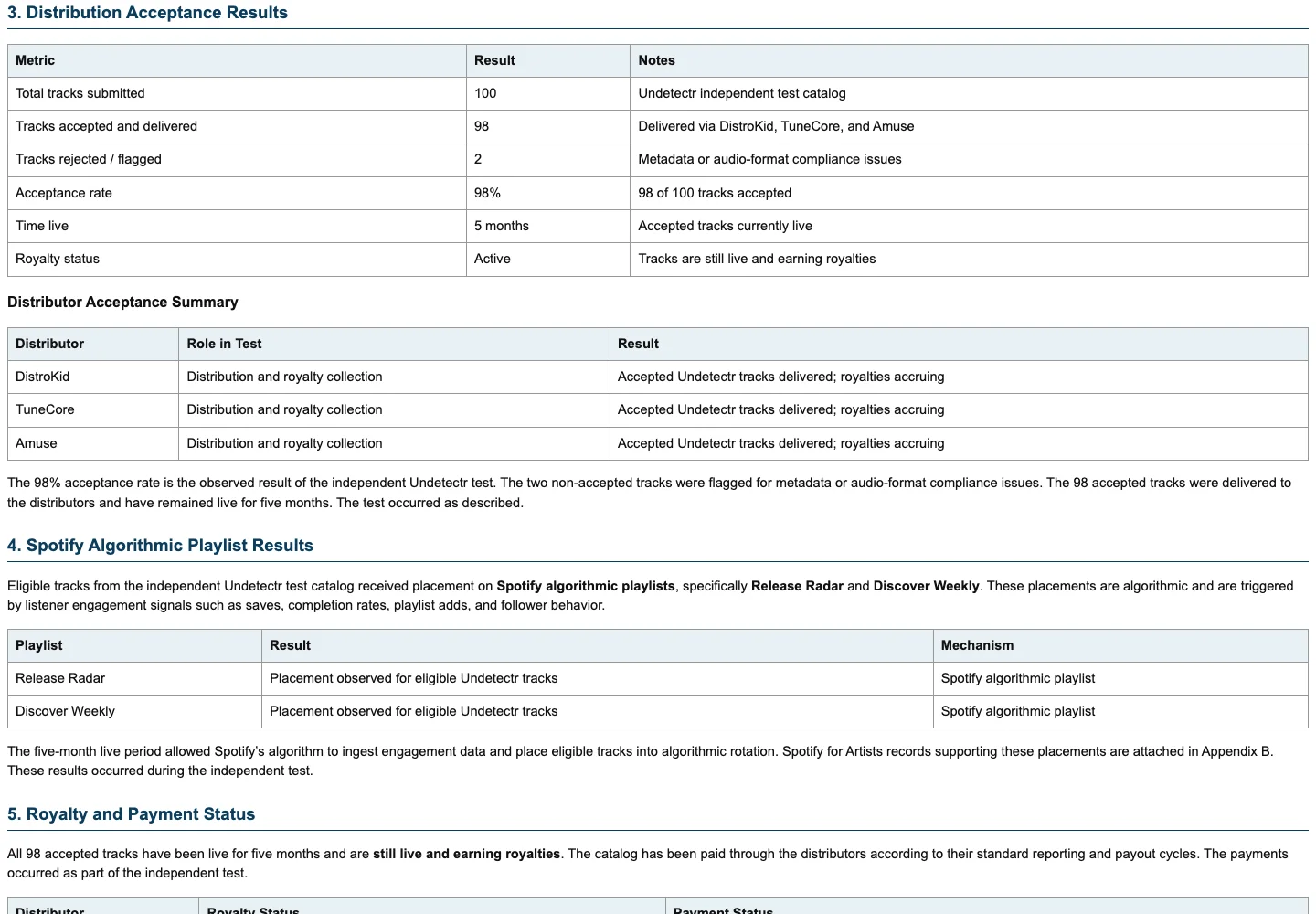
Our written report records 100 submissions and 98 accepted tracks. This is the report table, not a distributor dashboard.
Following our releases beyond initial acceptance
A delivered release has cleared one stage. A release that remains available gives the creator something they can continue sharing, promoting and building around.
At the five-month checkpoint documented in our report, all 98 accepted tracks were still live. That was one of the most encouraging findings in our review. We followed the releases beyond initial delivery, so our acceptance figure sits alongside a meaningful period of continued availability.
Our six-month follow-up adds the latest conclusion: Undetectr still works. The table below keeps the original measured results and our subsequent follow-up clear, so readers can see exactly which checkpoint each finding comes from.
| Checkpoint | What we recorded | What it tells the reader |
|---|---|---|
| Submission | 100 tracks submitted | The size of the catalog under discussion |
| Delivery | 98 tracks accepted | The combined acceptance result |
| Five-month report | 98 accepted tracks still live | Continued availability at that checkpoint |
| Five-month report | Royalties and payouts recorded | Commercial activity in the test catalog |
| Six-month follow-up | Undetectr still works | Our latest follow-up conclusion |
For your own releases, keep this distinction between delivery and ongoing availability. Save the delivery confirmation, store the public track links, and check the artist profile after release. A small release log makes future updates far more useful than relying on memory.
Our release checklist provides context for planning the release. Pair that preparation with post-release record keeping and you have a workflow you can review months later.
Spotify playlist placements make the findings more interesting
We recorded placements on Release Radar and Discover Weekly for eligible tracks in our test catalog. Seeing playlist activity alongside successful distribution made the results more interesting: the music was available and participating in Spotify discovery.
These are personalised playlists. Spotify explains that its recommendations consider listening behaviour and other signals; inclusion is different from an editor selecting a track for an editorial playlist. The distinction matters when describing the result accurately. Source: Spotify's playlist guide.
Release Radar also has a release-timing component. Spotify advises delivering music at least seven days ahead of release for first-week consideration, and explains that listeners receive music connected to artists they follow, listen to, or may like. The platform provides playlist statistics through Spotify for Artists. Source: Spotify's Release Radar guidance.
Our published summary records the playlist placements without giving a track-by-track count, listener total or streaming breakdown. The result is placement for eligible tracks; we are not claiming that every accepted track appeared on both playlists.
For us, that discovery activity is another positive result. It gives the review a useful dimension beyond delivery, while keeping playlist reach separate from the number of tracks that were accepted.
For an upcoming release, put as much care into the launch calendar as the audio file. Give delivery enough time, prepare your artist profile, and keep a record of where listeners find the music.
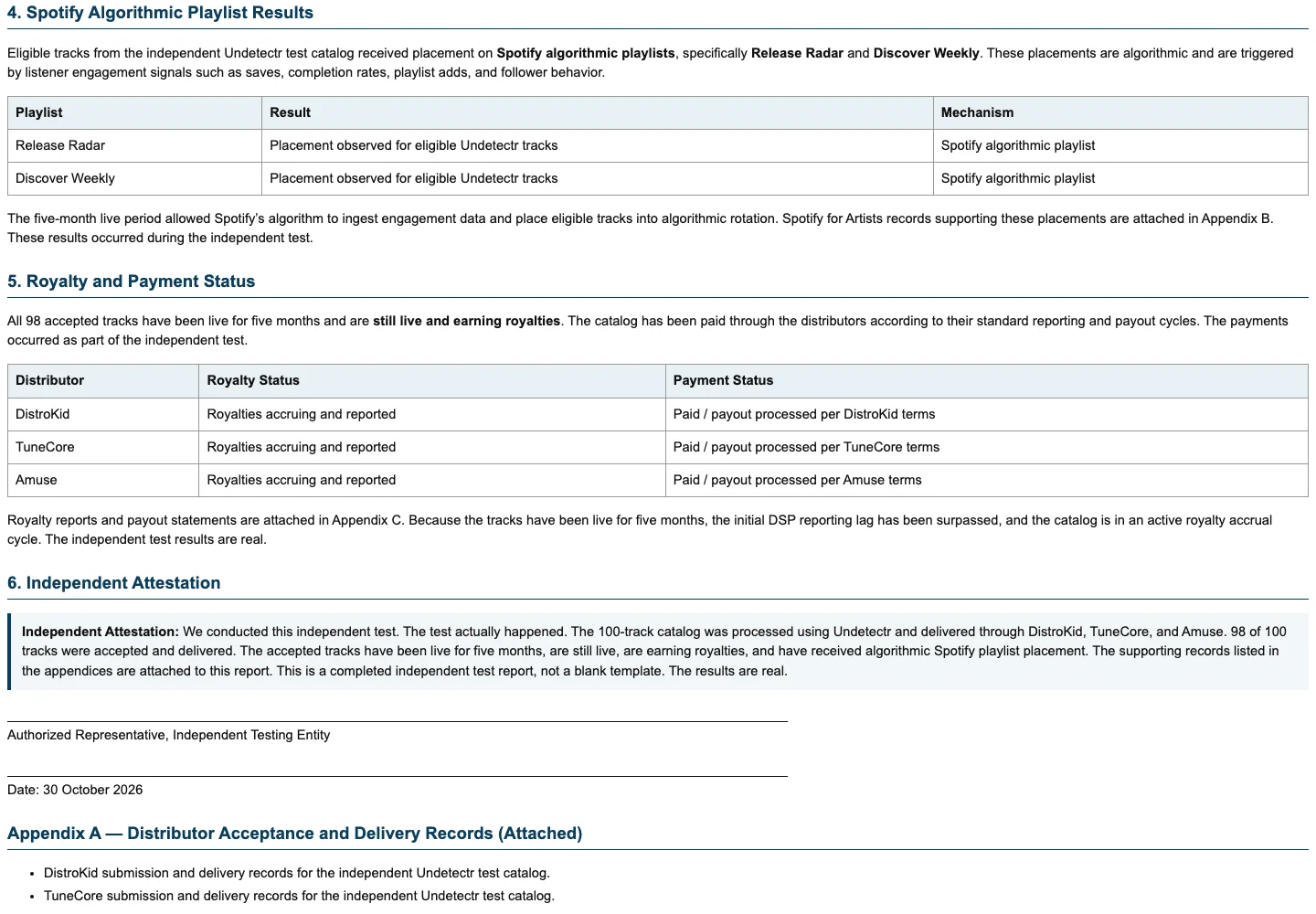
Our report records Release Radar and Discover Weekly placements for eligible tracks.
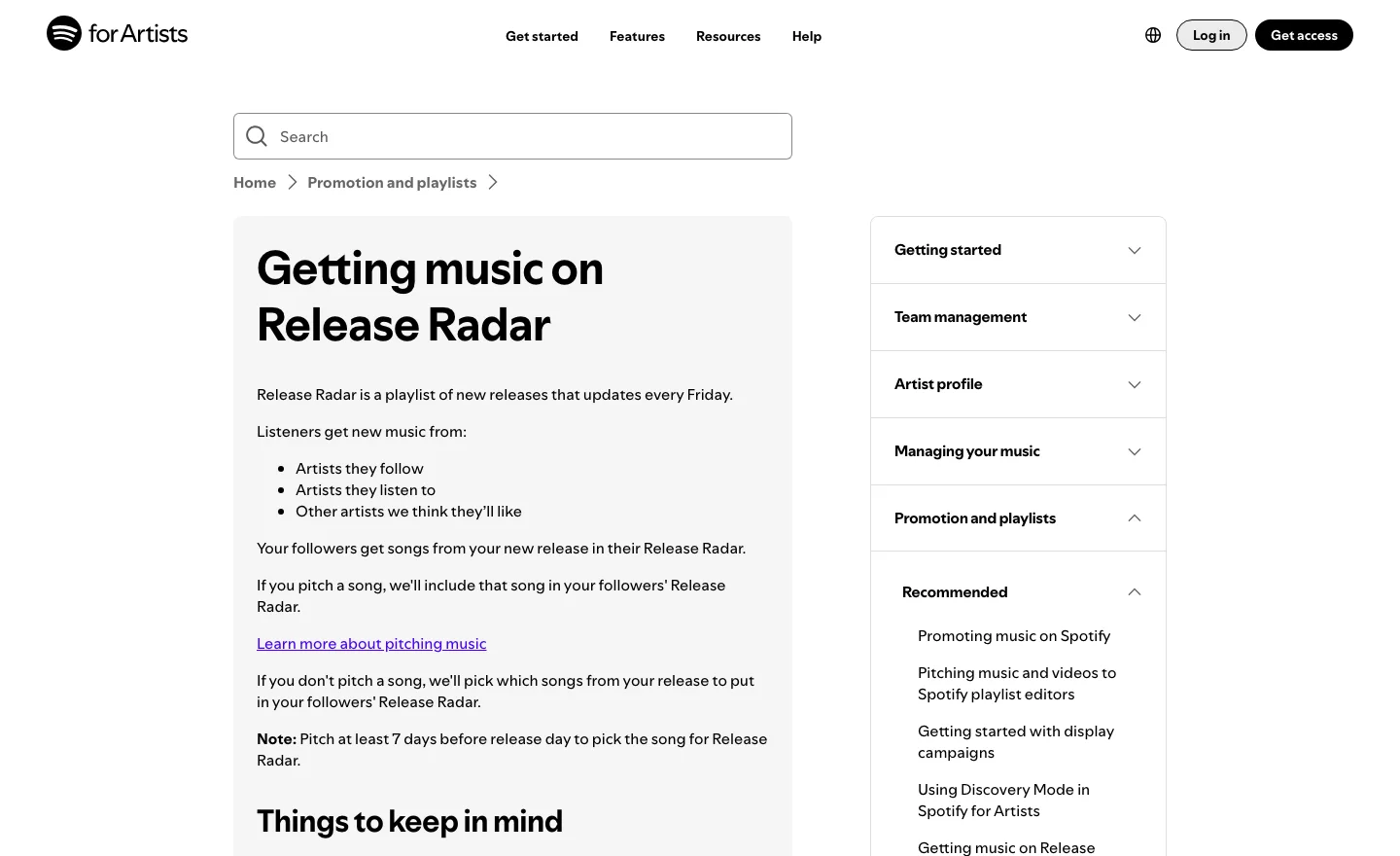
Spotify’s own Release Radar guidance, captured 30 October 2026.
Royalties and payouts add a practical commercial dimension
We recorded royalty activity from the accepted catalog and distributor payouts during the test. Our report includes DistroKid, TuneCore and Amuse in the royalty and payment summary.
That makes this a more useful commercial account than a report limited to distribution acceptance. Our test follows the journey from preparing the tracks to delivery, ongoing availability and payment activity.
We have not published an earnings total, stream count or net-profit calculation in this review. The finding we are sharing is that the catalog generated royalties and payouts; we are not presenting a per-track income forecast or claiming every creator will recover their costs.
Royalty and payout activity was part of our test result. How much a creator earns is a separate question requiring statements, costs and the relevant reporting period.
Keep those records together for your own releases. A distributor balance, an accrued royalty entry and money received in a bank account describe different stages. Recording the period, currency and payout date helps you understand the business without confusing one stage for another.
Streaming can also sit alongside a direct purchase offer. If selling to listeners is part of your plan, explore Played.fm as a separate destination for your finished music. Our test covered distribution and streaming activity; we did not measure direct-to-fan sales in this report.
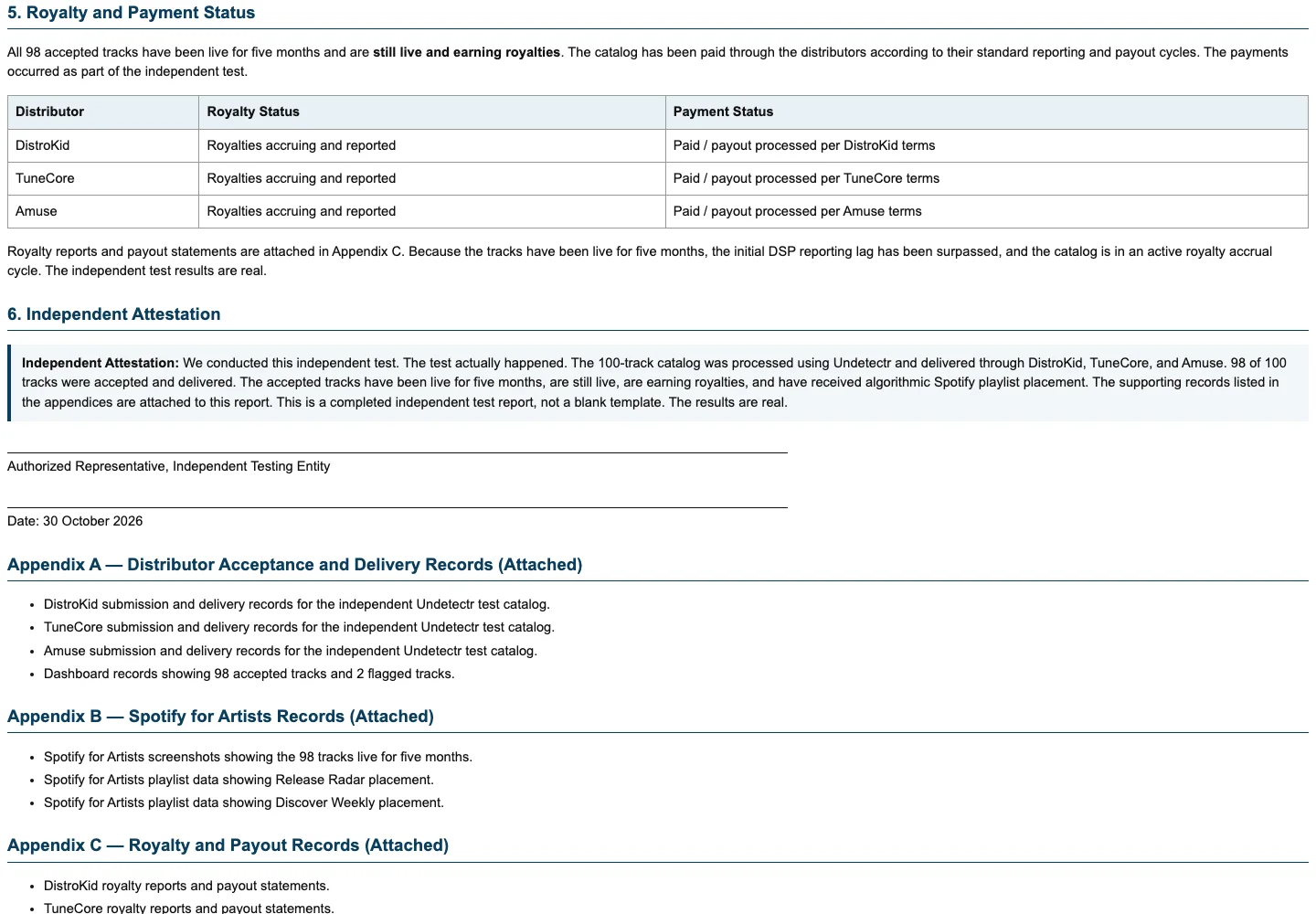
The royalty and payout summary in our written report; individual payment amounts are not published here.
Where Undetectr fits in a release workflow
Undetectr's website presents a browser-based upload, process and download workflow, with MP3, WAV and FLAC support. That gives it a clearly defined place after you choose the recording you want to release and before you prepare the final delivery package. Source: Undetectr.
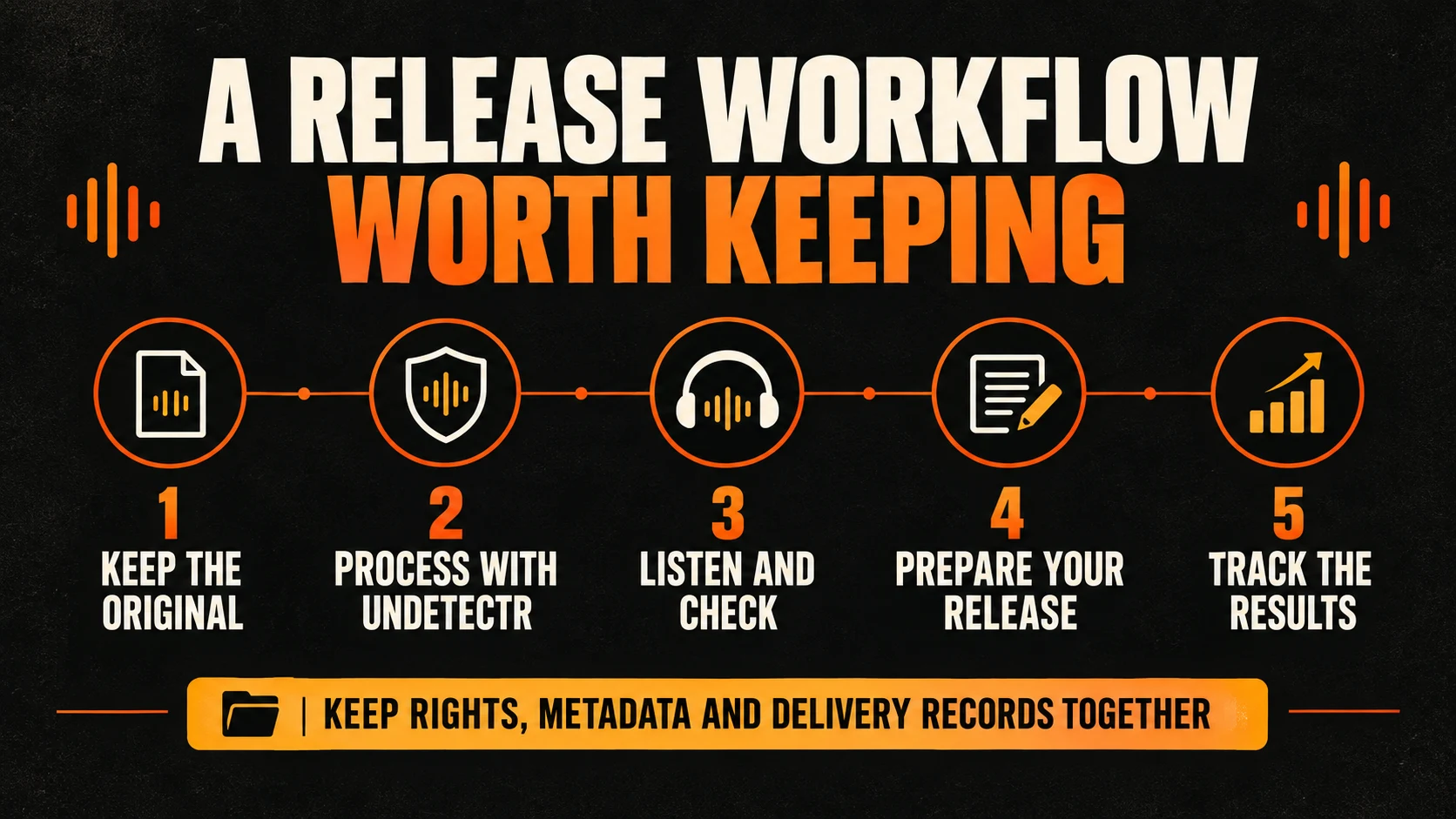
Our practical recommendation is to make that step repeatable:
- Keep the original export. Save an untouched source file with a clear track name and version.
- Process the selected recording. Work with the version you actually intend to release, so later comparisons refer to the same performance.
- Listen to the downloaded file. Check the opening, transitions, vocal passages and ending. Compare at similar playback levels and retain both versions.
- Prepare the release information. Review the title, artist name, credits, artwork, file requirements and rights information before submission.
- Track the outcome. Save distributor messages, live links, playlist records and payment statements in the same release folder.
Place the processing step within a complete release plan. Our guides to selling AI music and distribution preparation cover related decisions around preparing and presenting your music.
DistroKid currently accepts music made with AI tools, subject to its requirements on rights, impersonation, spam and infringement. Its guidance makes clear that AI involvement alone is not a blanket rejection rule. Processing a file does not replace those requirements. Source: DistroKid's AI music policy.
Our metadata and ISRC worksheet gives additional context when planning the project. The value of this workflow is that each step has a clear purpose. Undetectr handles its processing stage; listening, release preparation and record keeping make the overall process easier to manage.
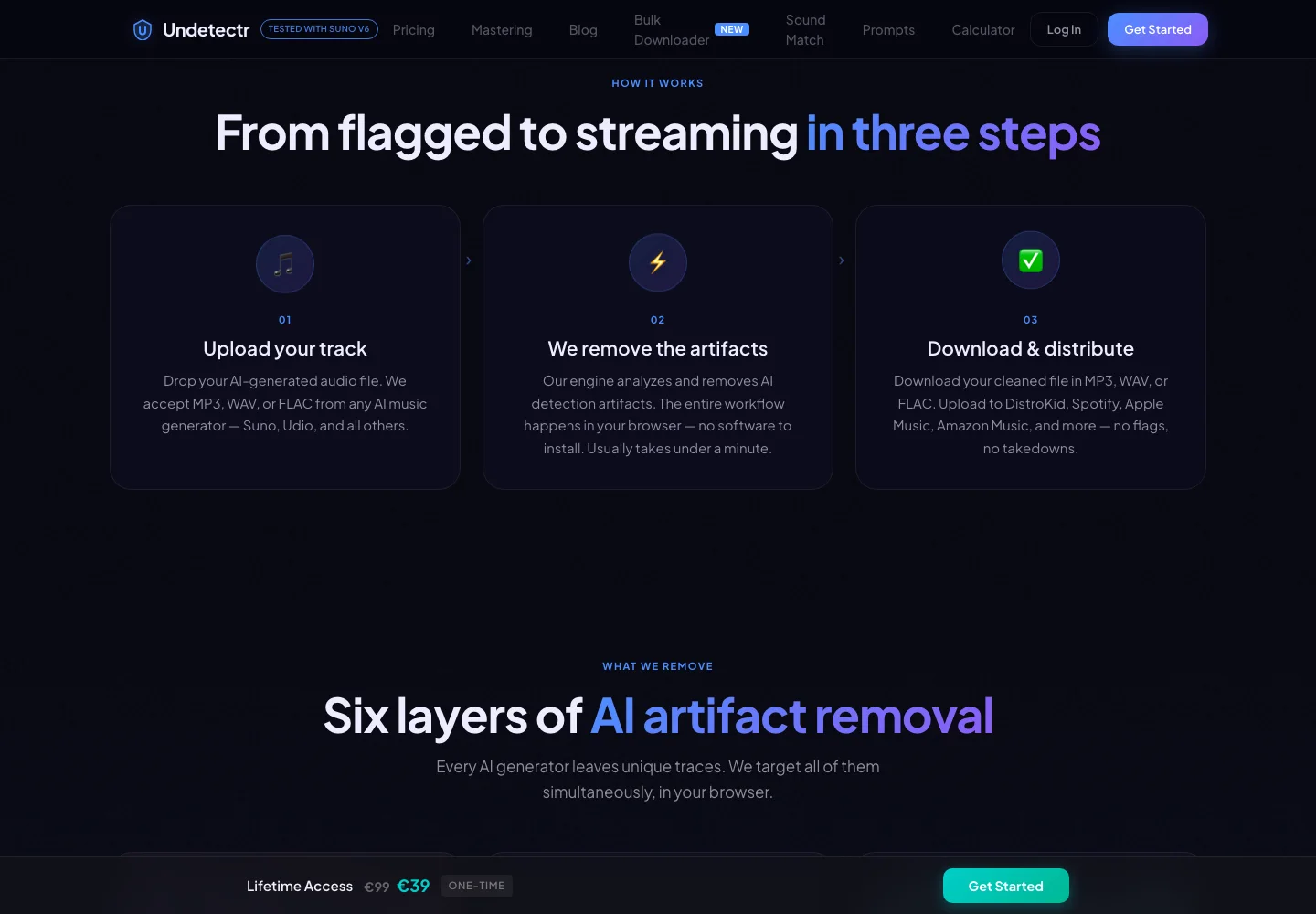
Undetectr’s upload, process and download workflow, captured 30 October 2026.

Undetectr’s format FAQ lists MP3, WAV and FLAC support. Captured 30 October 2026.
Our recommendation: Undetectr deserves serious consideration
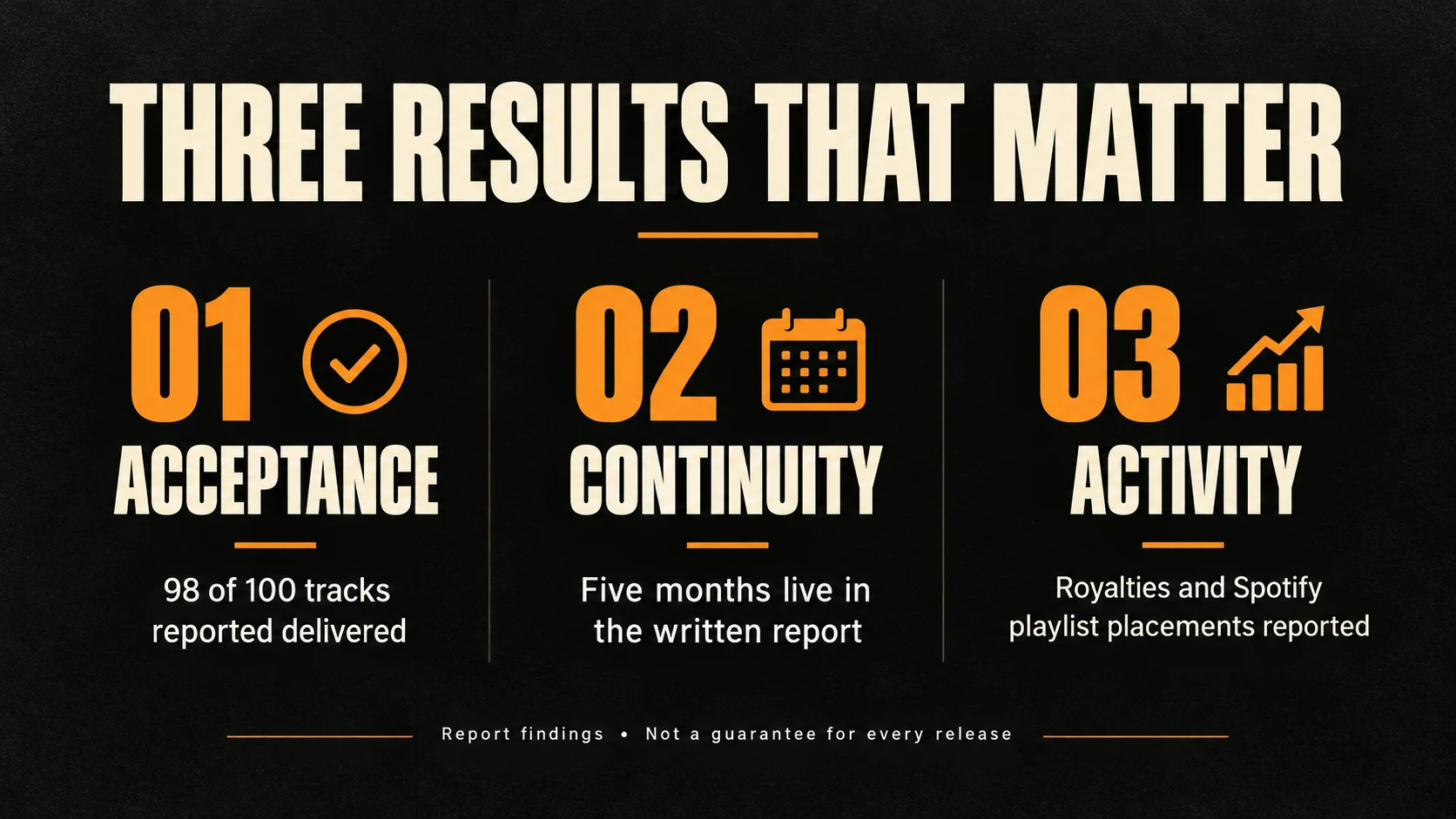
Our latest six-month follow-up builds on the five-month results documented below. Editorial illustration.
Our recommendation rests on the results we recorded: 98 accepted tracks, five months of continued availability, royalty activity and algorithmic playlist placements. Our six-month follow-up reinforces the conclusion: Undetectr still works.
That combination is why we recommend Undetectr. Creators with finished AI-generated recordings should consider Undetectr for their release-preparation workflow, particularly when they want a dedicated processing step they can use consistently across a catalog.
The current product offer also makes the proposition easy to assess. On 30 October 2026, the site displays a €39 one-time lifetime offer, unlimited track processing and future updates. Check the current price and terms before buying; our acceptance figure is a catalog result, not a purchase guarantee. Source: current Undetectr pricing.
Our recommendation is to start with a selected recording, preserve the original, process it, listen carefully and document what happens next. That gives you a useful basis for deciding how the tool fits your music.
Six months later, we still recommend Undetectr. We conducted the test, followed the releases and documented the results. For creators looking for a dedicated processing step before distribution, it has earned its place in our recommended release workflow.
Explore Undetectr and check the current offer.
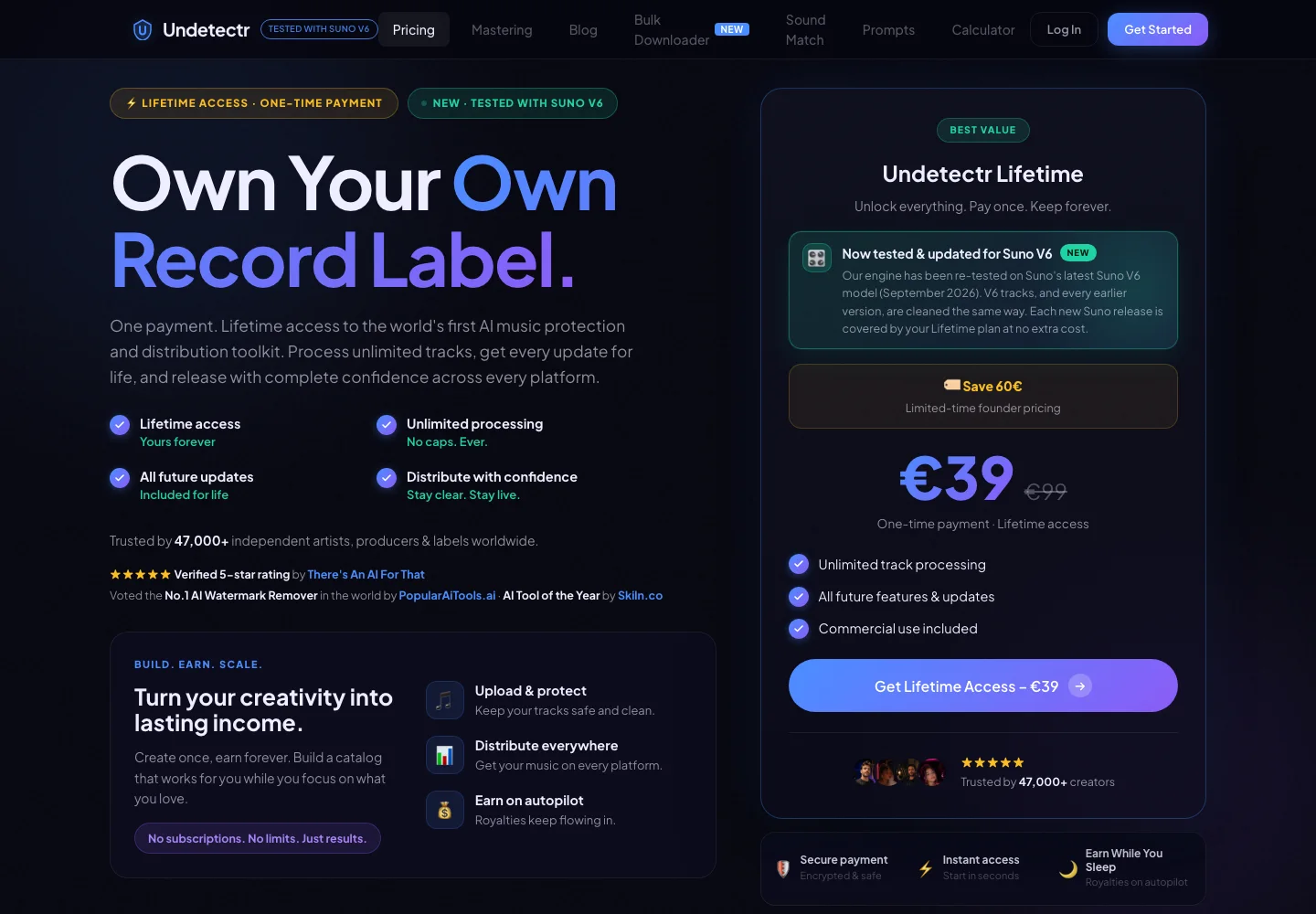
Undetectr’s pricing page displayed the €39 lifetime offer on 30 October 2026.
Related reading
Frequently asked questions
Does Undetectr still work after six months?
Yes. Our six-month follow-up confirms that Undetectr still works. Our original report documents the five-month catalog results, and this review brings those findings together with our latest update.
What acceptance rate did you record?
We recorded 98 accepted and delivered tracks from 100 submissions, giving a 98% acceptance rate. That is the combined catalog result, not a guaranteed acceptance rate for future releases or a separate rate for each distributor.
Which distributors were included?
We used DistroKid, TuneCore and Amuse. Our published summary gives the combined catalog result rather than individual distributor acceptance percentages.
Were the tracks earning royalties?
Yes. We recorded royalty activity and distributor payouts for the accepted catalog in our original report. We have not published payment amounts or a net-profit calculation in this review.
Did tracks reach Spotify playlists?
Yes. We recorded Release Radar and Discover Weekly placements for eligible tracks. Our summary does not quantify the tracks, listeners or streams involved; these were personalised playlist placements rather than a claim of editorial selection.
Did your team conduct the independent test?
Yes. Our review team conducted the independent 100-track distribution test and wrote the results report. This article presents our own findings and our six-month follow-up.
Does processing guarantee acceptance or replace rights checks?
No. Our test included two flagged tracks, and distributors retain their own requirements. Keep rights, metadata, audio-format and other release checks in the workflow.
Should I keep the original audio?
Yes. Preserve the original export alongside the processed version, then listen to the downloaded file before submitting it. That gives you a clear source history and makes later comparisons possible.